
Author: owendeuswalerbka993@gmail.com
-

Shocking: Israel Scientists Just Discovered a way for human to live 150 Years

Israel’s Discovery Could Help Humans Live Up to 150 Years
For decades, scientists around the world have been trying to understand the secret behind human aging. While the average human lifespan has increased significantly over the past century, living beyond 100 years is still considered rare. However, new research coming from Israel suggests that the future of human longevity could be far more extraordinary. Some scientists believe humans may eventually live up to 150 years or even longer.
Researchers in Israel have been studying the biological processes that cause aging in the human body. Aging is largely influenced by factors such as DNA damage, cell deterioration, and the gradual loss of the body’s ability to repair itself. Israeli scientists are now focusing on innovative ways to slow down or possibly reverse some of these processes.
One of the key areas of research involves understanding how cells age over time. Inside our bodies, cells constantly divide and repair tissues. But as we grow older, this process becomes less efficient. Scientists in Israel are studying how to protect and strengthen cells so that they can continue functioning effectively for a much longer period.
Another important aspect of this research focuses on longevity genes. Certain genes are believed to influence how quickly or slowly a person ages. Israeli researchers are examining how these genes work and whether they can be modified or supported through medical technology. If scientists can find ways to activate or enhance these longevity genes, it could significantly increase the human lifespan.
In addition to genetics, biotechnology is playing a major role in this research. Advanced medical technologies, including regenerative medicine and anti-aging treatments, are being explored to help the body repair itself more efficiently. Some experts believe that combining these technologies with healthier lifestyles could dramatically extend human life expectancy in the future.
Of course, living longer is not the only goal of longevity research. Scientists emphasize that the real objective is healthy aging. This means helping people stay active, independent, and disease-free for a much longer portion of their lives. Extending lifespan without improving health would not truly benefit society.
While the idea of living to 150 years may sound like science fiction today, many experts believe medical breakthroughs over the next few decades could make it more realistic. Just a century ago, the average life expectancy in many countries was around 40 to 50 years. Today, people commonly live into their 70s and 80s thanks to advances in medicine, nutrition, and public health.
If the research being conducted in Israel continues to progress, the concept of a 150-year lifespan may no longer seem impossible. Although there is still much work to be done, scientists are optimistic that understanding the science of aging could unlock new possibilities for the future of humanity.
For now, the idea of living to 150 remains a fascinating glimpse into what the future of medicine might hold. As research continues, the world will be watching closely to see whether this remarkable milestone can eventually become reality.
-

From Shelter to Stardom: How One Oversized Cat Won Everyone’s Heart
It’s not every day that a 40-pound cat becomes an internet celebrity — but that’s exactly what happened when a lovable orange-and-white feline captured hearts across social media.
The story began at , where staff members welcomed an unusually large cat named Patches. Weighing in at over 40 pounds, he was far bigger than the average house cat. While his size raised health concerns, his gentle personality immediately won over the shelter team.
Instead of simply listing him as available for adoption, the shelter shared a playful and honest social media post introducing Patches to the world. They described him with humor, highlighting his “extra fluff” while also making it clear that he would need a committed owner ready to help him on a serious weight-loss journey. The internet responded instantly.
Within days, the post was shared thousands of times. Animal lovers from across the country commented, laughed, and expressed concern — but most importantly, they showed interest in giving him a home. What could have been just another adoption listing turned into a viral moment filled with compassion and support.
But beyond the jokes and headlines was a deeper message. Obesity in pets can lead to serious health issues, including diabetes, joint pain, and heart problems. The shelter made sure potential adopters understood that loving Patches meant helping him live a longer, healthier life.
Thankfully, the perfect match stepped forward. A caring adopter saw beyond the number on the scale and focused on his sweet nature. After meeting him and speaking with shelter staff, she committed to providing not just affection, but also structure, proper nutrition, and veterinary care.
Now in his forever home, Patches is beginning a new chapter. With a carefully monitored diet and gradual activity plan, he’s on the road to better health. Progress may be slow, but it’s steady — and he’s surrounded by love every step of the way.
His journey reminds us that every animal deserves a chance, no matter their size or circumstances. Sometimes, a little extra weight just means there’s more to love — and with the right support, even the biggest challenges can shrink over time.
-
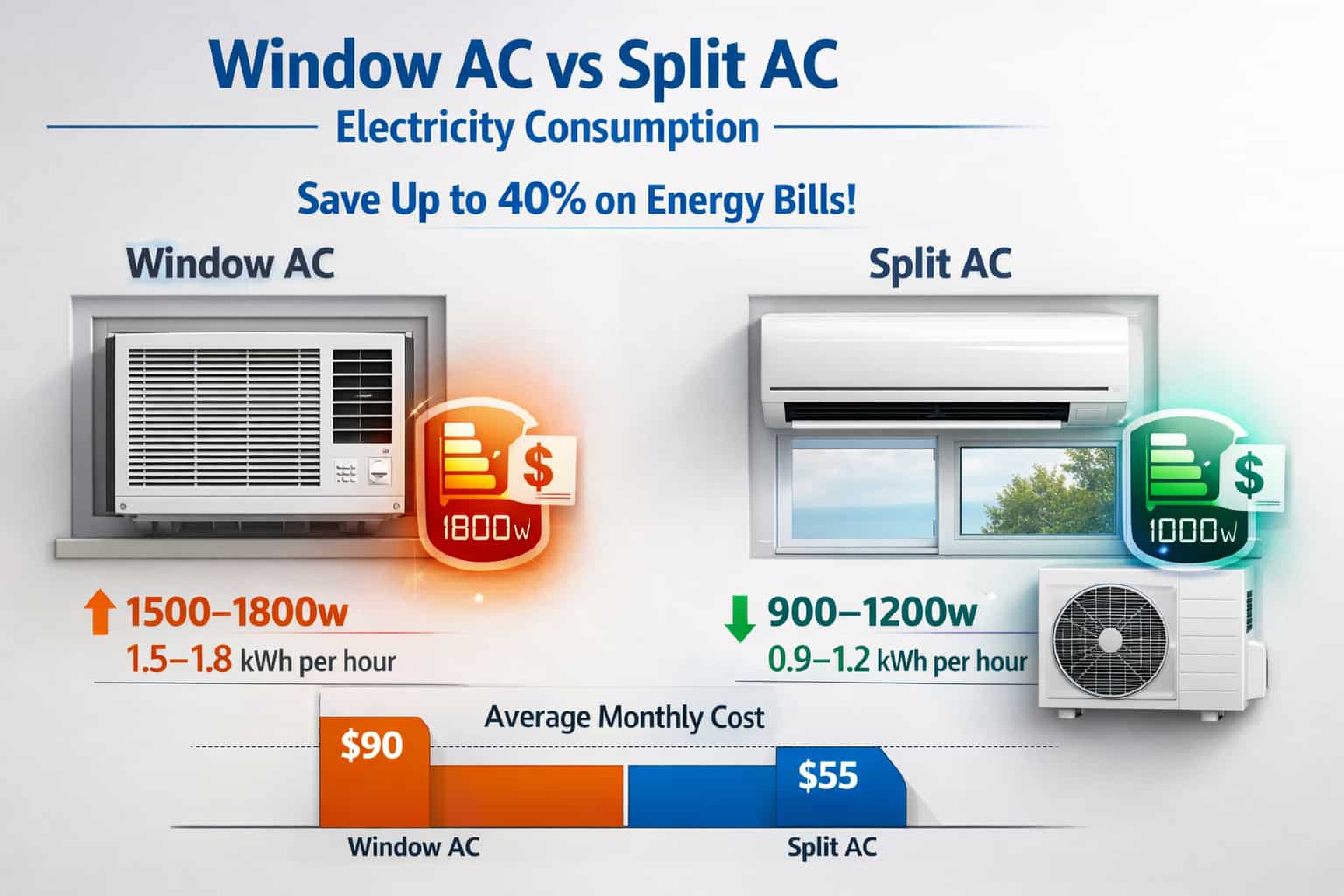
Which One Saves More Power: Window AC vs Split AC Electricity Consumption
Table of Contents
When the temperature starts soaring during summers, buying an AC is no longer a luxury; it is essential. But while choosing an AC, one question always is at the forefront: Window AC vs Split AC electricity consumption-which one consumes lesser power?
Electricity bills are a major headache for the owners of a house, and this headache could be really bad during peak summer months. So understanding the difference between Window AC and Split AC electricity consumption will help you reach a smart, cost-effective decision.
In this detailed guide, we will explain power use, efficiency, real-world cost comparisons, and practical tips to help you choose the right AC for your home.
Understanding the Concept of Electricity Consumption in Air Conditioning Units
Before we go into a comparison between Window AC vs Split AC electricity consumption, let’s understand how AC power consumption works.
Air conditioners require electricity in units of:
- Watts (W) – Instant Power Usage
- Kilowatt-hours (kWh) – Units Charged in Electricity Bills
For example:
Also, if your air conditioner uses 1.5 kW of electric power and runs for 8 hours, it would use:
1.5 × 8 = 12 units per day
The more hours you run your AC, i.e., the higher its wattage, the higher your bills would be.
Window AC VS Split AC Electricity Consumption: Basic Design Difference
The fundamental difference in terms of electricity usage between Window AC and Split AC is rooted in the former’s design and cooling system.
Window AC
- Single compact unit
- Compressor and condenser inside one box
- Installed in a window or a wall
- Slightly Less Efficient Heat Dissipation
Split AC
- Two units: One indoor and one outdoor
- Compressor placed outside
- Improving Airflow and Cooling Capabilities
- More energy-efficient design
Since these ACs have a split configuration where the compressor will be a separate component, it means this type of AC will handle heat better and, therefore, have a significant effect on Window AC vs Split AC electricity consumption.
Power Consumption Comparison (1.5 Ton Example)
Let’s compare a common 1.5-ton AC:
Feature Window AC Split AC Average Power Rating 1200–1600 W 1000–1500 W Cooling Efficiency Moderate High Inverter Option Rare Common Electricity Consumption Higher Lower In real-world usage, Window AC vs Split AC electricity consumption shows that split ACs usually consume 10–15% less electricity than window ACs of the same capacity and star rating.
Role of Star Ratings in Electricity Usage
In Window AC vs Split AC electricity consumption evaluation, ratings have a huge impact.
Air conditioners are rated with 1 to 5 star marks, signifying efficiency in the usage of power.
⭐ 5-Star AC = Maximum energy saving
⭐ 1-Star AC = Higher electricity consumption
Even in this case, a 5-star split AC works better than a 5-star window AC in the comparison of electricity consumption between the two types of air conditioners.
Example: Annual Usage Estimate for 1.5 Ton 5-Star
Window AC: 1200–1450 units/year
Split AC: 1000–1250 units/year
That’s a difference of about 150–200 units per year.
Inverter Technology: The Game Changer
Another major factor in electricity consumption between Window AC and Split AC is Inverter Technology.
What is Inverter AC?
An inverter AC is able to do this by changing the speed of the compressor in response to changing room temperature. It does not switch on and off like other air conditioners.
Benefits:
- Lower electricity usage
- Stable cooling
- Reduced Power Spikes
Inverter technology is usually included with split AC devices, but many window AC devices are non-inverter devices.
This is one of the biggest reasons why Window AC vs Split AC electricity consumption comparison tend to favor the latter.
True Comparison of Electricity Bills
Let’s say
- AC runs 8 hours daily
- Used for 150 summer days
- Electricity rate = ₹8 per unit
Window AC:
Average daily consumption: 8–9 units
Seasonal usage: ~1200–1350 units
Electricity bill (in rupees): 9600–10,800
Split AC:
Average daily consumption: 6.5–8 units
Seasonal consumption: ~ 1000–1200 units
Electricity bill: ₹ 8000–₹ 9600
In this practical example, Window AC vs Split AC electricity consumption has shown split AC saving approximately ₹1000–₹1500/season.
Translated over 5 years, that’s a lot of savings.
Does the Size of the Room Influence Its Electrical Consumption?
Yes, absolutely.
When comparing Window AC vs Split AC electricity consumption, it is important to note that the capacity of the AC to be bought has to match the room size.
Recommended Guide:
- Up to 120 sq. ft → 1 Ton
- 120–200 Sq Ft → 1.5 Ton
- 200-300 sq. ft → 2 Ton
If you install a higher tonnage than needed:
- It cools fast but cycles often
- Electricity usage increases
If the capacity is too small:
- Runs longer hours
- Increased overall power consumption
It’s pertinent to mention that accurate sizing plays a crucial role in the evaluation of Window AC vs Split AC electricity consumption.
Other Factors Affecting the Consumption of Electricity
Besides the basic comparison of Window AC vs Split AC electricity consumption, several external factors make a difference to your bill:
1. Temperature Setting
Each degree lower raises electricity use by 6–10%.
Ideal environment: 24–26°C
2. Insulation
Poor insulation makes an AC work harder.
3. Maintenance
This corresponds to dirty filters increasing power use by as much as 15%.
4. Pattern of Use
Continuous running vs frequent ON/OFF: the differences in electricity consumption are a factor.
Advantages of Window AC
Though the electricity consumption for Window AC vs. Split AC favors the latter, there are some benefits of using window AC:
- Lower Initial Costs
- Easy Installation
- Compact design
- Suitable for small rooms
If the budget is tight and the usage hours are limited, then a window AC can still work.
Final Verdict: Window AC vs Split AC Electricity Consumption
So, who emerges victorious in the fight between the electricity consumption of Window AC and Split AC?
If you want to reduce your electricity bills, you should consider a Split AC (preferably a 5-star inverter).
If you are looking for a product with a low installation cost and easy installation, you can consider a window AC.
However, in most cases, split ACs require lesser electricity and are more comfortable.
Conclusion
Knowledge of Window AC and Split AC power consumption can aid you in choosing a better option. Though both options provide optimal cooling, a split AC is better with minimal power consumption because of its better designing and inverter philosophy.
Selecting the appropriate capacity, taking good care of your AC, and ensuring the correct temperature will help reduce your electricity bills further.
Therefore, before you go out and acquire your next AC unit, it is important to evaluate Window AC vs Split AC on electricity consumption and make an appropriate choice depending on your budget and needs.
Stay cool – and save smart!
-
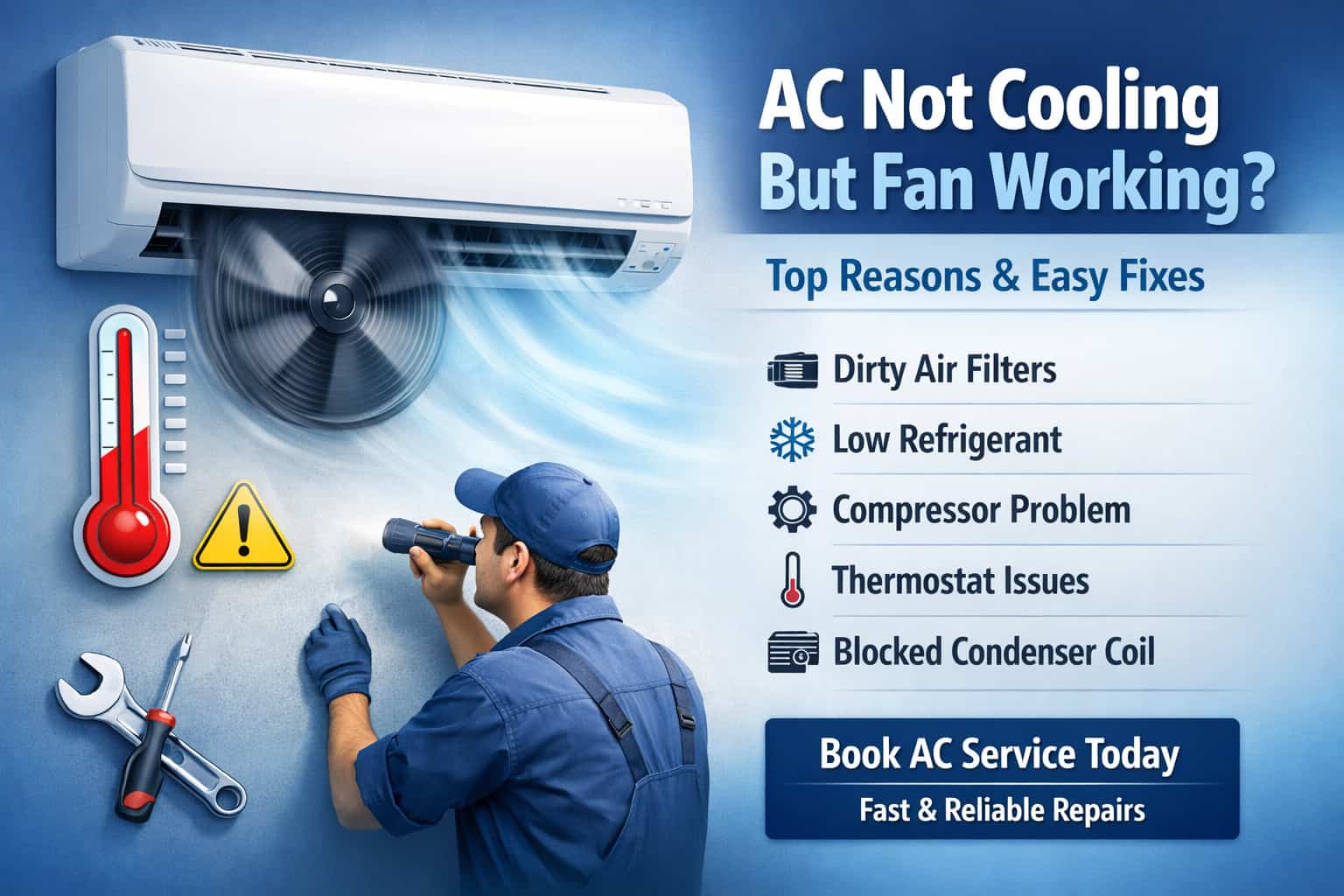
AC Not Cooling, But the Fan is Running – Reasons & Fix (Complete Guide)
Have you encountered a situation where your Air Conditioner is not cooling but the fan is working properly? You’re not alone, and this is one of the most common Air Conditioner issues faced by users, especially during the peak summer season. The Air Conditioner will start, the fan will spin correctly, and air will be blowing from the vents, but the room will not be cooling.
If your AC is not cooling but the fan working problem is driving you crazy, don’t worry. In this guide, we aim to walk you through the most common causes of the problem and possible fixes for you to attempt before consulting a professional.
Let’s fix your cooling problem step by step.
Why isn’t your AC cooling when the fan is working?
Generally, when AC is not cooling but the fan is working, it tries to explain that the cooling process is interrupted, while the system of airflow is working. Air conditioners need refrigerant, coils, compressors, and appropriate airflow in order for them to extract heat from your home.
If any of these components fail, you will begin to face the irritating problem of the AC not cooling with a working fan.
1. Dirty or Clogged Air Filter
One of the most common reasons for AC not cooling but fan working is a dirty air filter.
Why It Happens:
Usually, an air filter catches dust, dirt, and allergens. After some time, it gets choked and obstructs the airflow. Then, the evaporator gets frozen, and your AC unit won’t work.
Signs:
- Weak airflow from vents
- Ice formations on coils
- Higher electricity bills
Fix:
- Turn off your AC
- Remove and inspect the air filter
- Clean or replace it if dirty
It is recommended that AC filters be changed every 1-3 months in order to avoid the AC not cooling, fan working problem.
2. The Thermostat Settings Are Incorrect
Sometimes, the solution may be easier than you thought. It is possible that you may have forgotten that your thermostat is set on “Fan Only” instead of “Cool.” That will cause you to experience an issue with the “AC not cooling but fan working” problem.
Fix:
- Ensure thermostat is set to Cool Mode
- Lower the temperature setting
- Replace old batteries
- Upgrade to a smart thermostat as needed
Many panic when they encounter AC not cooling but the fan working issue. The thermostat settings should be the first thing you should consider.
3. Dirty or Blocked Outdoor Condenser Unit
Your outdoor device will have to release heat out of your house. This means if there’s dirt, leaves, and so on accumulated on it, then your AC will not cool but your fan will work.
Signs:
- Warm air from vents
- The outdoor unit feels extremely hot
- Loud noises outside
Fix:
- Switch off the power to the AC
- Remove Debris Around the Unit
- Gently rinse condenser coils using a hose
Cleaning the outdoor unit can quickly resolve the problem of the AC not cooling but the fan working.
4. Low Refrigerant Levels
It is the refrigerant that cools the air. If there is any leakage, your AC will keep running and won’t cool as it should, which leads to the very common complaint of AC not cooling but the fan working.
Signs
- Ice on refrigerant lines
- Hissing sounds
- AC runs continuously without cooling.
Fixes:
Low refrigerant calls for expert repair. A certified HVAC technician will:
- Leak detection
- Repair broken lines
- Recharge refrigerant
Specifically, if your AC is not cooling but the fan is working and basic cleaning has not resolved the issue, then the refrigerant levels should be checked.
5. Frozen Evaporator Coils
Another major cause of AC not cooling but the fan running is frozen coils.
Why It Happens:
- Dirty Air Filter
- Low refrigerant
- Poor airflow
Signs:
- Ice on indoor unit
- Water leakage during melting of ice
- Weak cooling
Fix:
- Turn off AC immediately
- Let coils thaw completely
- Replace air filter
- Call a technician if freezing continues
Ignoring the frozen coils can cause the AC not cooling but fan working issue.
6. Faulty Compressor
The compressor is the heart of your AC system, and when your compressor fails, you will feel the effect since the AC will blow air, but the system will not cool, thus AC not cooling but fan working.
Signs:
- Clicking sounds
- Outdoor unit not starting
- AC runs but the room stays warm
Fix:
Problems concerning compressors must be treated by experts. Sometimes replacement may be required.
If your unit is more than 10-12 years old, a malfunctioning compressor could be a possible cause for the “AC not cooling, but fan is working” situation.
7. Leaky or Damaged Duct
Central air conditioning systems, for instance, use ducts to circulate cool air around the house. As such, if there is cooling, there is a feeling of the AC not cooling but the fan working.
Signs:
- Uneven Cooling
- High energy bills
- Weak airflow in particular rooms
Fix:
- Inspect visible ductwork
- Use duct sealant to seal small leaks
- For significant duct repairs, it is best to call professionals
Proper sealing of the ducts ensures efficiency. Proper sealing of the ducts resolves the AC not cooling but fan working issue.
8. Electrical or Capacitor Issues
Various electrical components help control how your AC operates. If a capacitor is faulty, the AC unit may not cool but fan works.
Signs:
- AC will not start
- Buzzing noises
- System shuts off randomly
Fix:
An electrician is always needed to fix electric problems because of safety considerations.
Preventive Maintenance Tips
In order to avoid the hassle of AC not cooling but fan working again, follow these maintenance tips:
Monthly:
Check and replace air filters
Every 3-6 Months:
- Clean outdoor condenser
- Check thermostat settings
Annually:
- Schedule professional AC servicing
- Check refrigerant levels
- Inspect electrical components
The risk of AC not cooling, yet fan is working, is significantly reduced by regular maintenance, especially during peak summer.
Preventive Maintenance Tips
In order to avoid the hassle of AC not cooling but fan working again, follow these maintenance tips:
Monthly:
- Check and replace air filters
- Every 3-6 Months
- Clean outdoor condenser
- Check thermostat settings
Annually
- Schedule professional AC servicing
- Check refrigerant levels
- Inspect electrical components
The risk of AC not cooling, yet fan is working, is significantly reduced by regular maintenance, especially during peak summer.
When to Call a Professional?
You should contact an expert in HVAC if:
- Suspected of Refrigerant Leak
- Compressor is not working
- Electrical components fail
- AC repeatedly freezes
If basic troubleshooting doesn’t resolve the AC not cooling, but the fan works problem, then the safest option is hiring a professional.
Final Thoughts
It is quite stressful to deal with an AC not cooling but fan working, most especially during days of extreme weather. Nonetheless, in most circumstances, the reasons are not as intricate as people think; they only lie in minor problems.
Based on the above, by understanding the reasons and how to fix them, you can easily and quickly improve the comfort in your house.
When still experiencing AC not cooling but fan working problems, don’t hesitate in seeking professional help. This is to avoid extensive damages and AC replacements.
For more home maintenance guides and troubleshooting tips, please visit:
👉 https://homemaintenanceblog.site/
-
Hello world!
Welcome to WordPress. This is your first post. Edit or delete it, then start writing!