Table of Contents
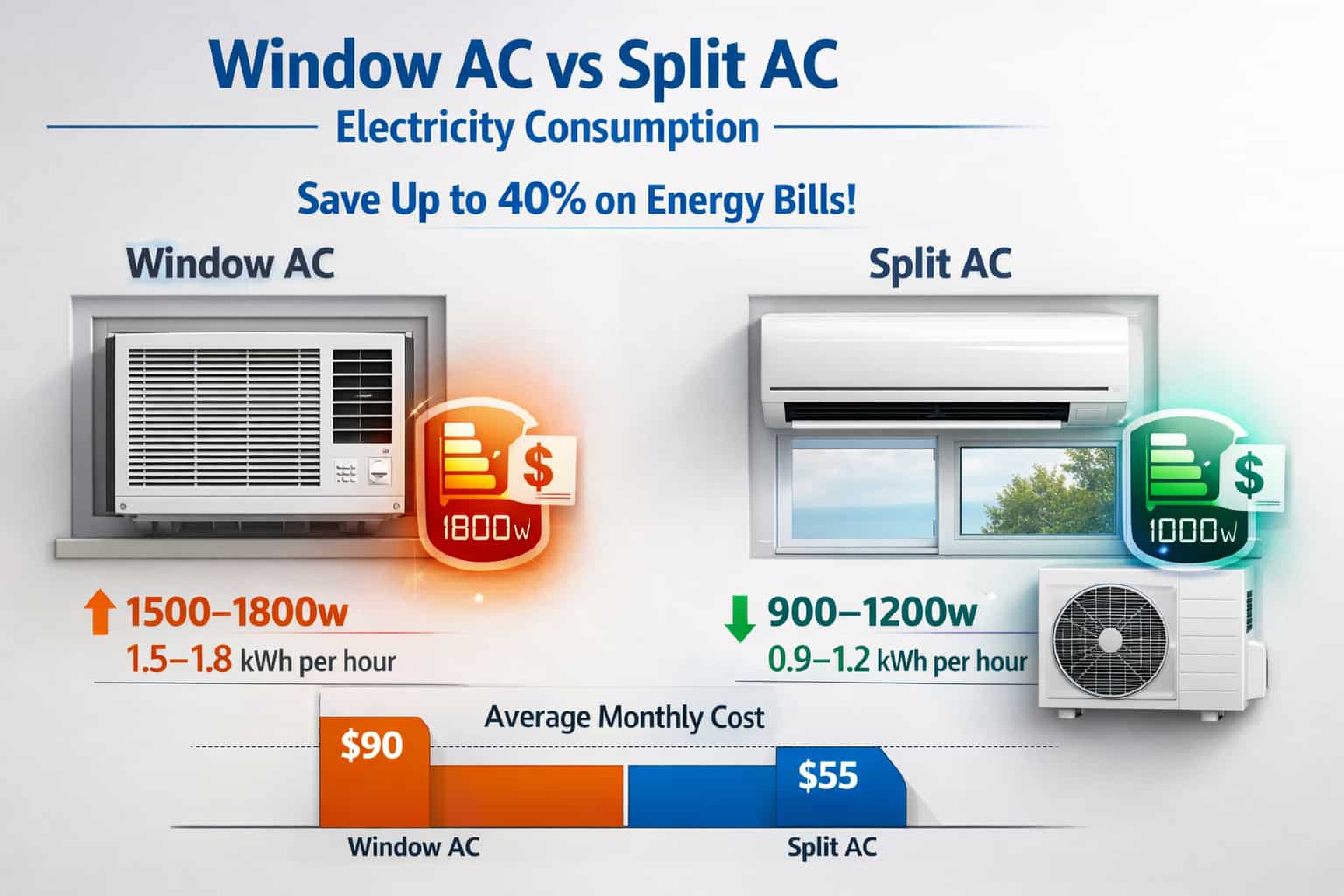
When the temperature starts soaring during summers, buying an AC is no longer a luxury; it is essential. But while choosing an AC, one question always is at the forefront: Window AC vs Split AC electricity consumption-which one consumes lesser power?
Electricity bills are a major headache for the owners of a house, and this headache could be really bad during peak summer months. So understanding the difference between Window AC and Split AC electricity consumption will help you reach a smart, cost-effective decision.
In this detailed guide, we will explain power use, efficiency, real-world cost comparisons, and practical tips to help you choose the right AC for your home.
Understanding the Concept of Electricity Consumption in Air Conditioning Units
Before we go into a comparison between Window AC vs Split AC electricity consumption, let’s understand how AC power consumption works.
Air conditioners require electricity in units of:
- Watts (W) – Instant Power Usage
- Kilowatt-hours (kWh) – Units Charged in Electricity Bills
For example:
Also, if your air conditioner uses 1.5 kW of electric power and runs for 8 hours, it would use:
1.5 × 8 = 12 units per day
The more hours you run your AC, i.e., the higher its wattage, the higher your bills would be.
Window AC VS Split AC Electricity Consumption: Basic Design Difference
The fundamental difference in terms of electricity usage between Window AC and Split AC is rooted in the former’s design and cooling system.
Window AC
- Single compact unit
- Compressor and condenser inside one box
- Installed in a window or a wall
- Slightly Less Efficient Heat Dissipation
Split AC
- Two units: One indoor and one outdoor
- Compressor placed outside
- Improving Airflow and Cooling Capabilities
- More energy-efficient design
Since these ACs have a split configuration where the compressor will be a separate component, it means this type of AC will handle heat better and, therefore, have a significant effect on Window AC vs Split AC electricity consumption.
Power Consumption Comparison (1.5 Ton Example)
Let’s compare a common 1.5-ton AC:
| Feature | Window AC | Split AC |
| Average Power Rating | 1200–1600 W | 1000–1500 W |
| Cooling Efficiency | Moderate | High |
| Inverter Option | Rare | Common |
| Electricity Consumption | Higher | Lower |
In real-world usage, Window AC vs Split AC electricity consumption shows that split ACs usually consume 10–15% less electricity than window ACs of the same capacity and star rating.
Role of Star Ratings in Electricity Usage
In Window AC vs Split AC electricity consumption evaluation, ratings have a huge impact.
Air conditioners are rated with 1 to 5 star marks, signifying efficiency in the usage of power.
⭐ 5-Star AC = Maximum energy saving
⭐ 1-Star AC = Higher electricity consumption
Even in this case, a 5-star split AC works better than a 5-star window AC in the comparison of electricity consumption between the two types of air conditioners.
Example: Annual Usage Estimate for 1.5 Ton 5-Star
Window AC: 1200–1450 units/year
Split AC: 1000–1250 units/year
That’s a difference of about 150–200 units per year.
Inverter Technology: The Game Changer
Another major factor in electricity consumption between Window AC and Split AC is Inverter Technology.
What is Inverter AC?
An inverter AC is able to do this by changing the speed of the compressor in response to changing room temperature. It does not switch on and off like other air conditioners.
Benefits:
- Lower electricity usage
- Stable cooling
- Reduced Power Spikes
Inverter technology is usually included with split AC devices, but many window AC devices are non-inverter devices.
This is one of the biggest reasons why Window AC vs Split AC electricity consumption comparison tend to favor the latter.
True Comparison of Electricity Bills
Let’s say
- AC runs 8 hours daily
- Used for 150 summer days
- Electricity rate = ₹8 per unit
Window AC:
Average daily consumption: 8–9 units
Seasonal usage: ~1200–1350 units
Electricity bill (in rupees): 9600–10,800
Split AC:
Average daily consumption: 6.5–8 units
Seasonal consumption: ~ 1000–1200 units
Electricity bill: ₹ 8000–₹ 9600
In this practical example, Window AC vs Split AC electricity consumption has shown split AC saving approximately ₹1000–₹1500/season.
Translated over 5 years, that’s a lot of savings.
Does the Size of the Room Influence Its Electrical Consumption?
Yes, absolutely.
When comparing Window AC vs Split AC electricity consumption, it is important to note that the capacity of the AC to be bought has to match the room size.
Recommended Guide:
- Up to 120 sq. ft → 1 Ton
- 120–200 Sq Ft → 1.5 Ton
- 200-300 sq. ft → 2 Ton
If you install a higher tonnage than needed:
- It cools fast but cycles often
- Electricity usage increases
If the capacity is too small:
- Runs longer hours
- Increased overall power consumption
It’s pertinent to mention that accurate sizing plays a crucial role in the evaluation of Window AC vs Split AC electricity consumption.
Other Factors Affecting the Consumption of Electricity
Besides the basic comparison of Window AC vs Split AC electricity consumption, several external factors make a difference to your bill:
1. Temperature Setting
Each degree lower raises electricity use by 6–10%.
Ideal environment: 24–26°C
2. Insulation
Poor insulation makes an AC work harder.
3. Maintenance
This corresponds to dirty filters increasing power use by as much as 15%.
4. Pattern of Use
Continuous running vs frequent ON/OFF: the differences in electricity consumption are a factor.
Advantages of Window AC
Though the electricity consumption for Window AC vs. Split AC favors the latter, there are some benefits of using window AC:
- Lower Initial Costs
- Easy Installation
- Compact design
- Suitable for small rooms
If the budget is tight and the usage hours are limited, then a window AC can still work.
Final Verdict: Window AC vs Split AC Electricity Consumption
So, who emerges victorious in the fight between the electricity consumption of Window AC and Split AC?
If you want to reduce your electricity bills, you should consider a Split AC (preferably a 5-star inverter).
If you are looking for a product with a low installation cost and easy installation, you can consider a window AC.
However, in most cases, split ACs require lesser electricity and are more comfortable.
Conclusion
Knowledge of Window AC and Split AC power consumption can aid you in choosing a better option. Though both options provide optimal cooling, a split AC is better with minimal power consumption because of its better designing and inverter philosophy.
Selecting the appropriate capacity, taking good care of your AC, and ensuring the correct temperature will help reduce your electricity bills further.
Therefore, before you go out and acquire your next AC unit, it is important to evaluate Window AC vs Split AC on electricity consumption and make an appropriate choice depending on your budget and needs.
Stay cool – and save smart!
Leave a Reply